


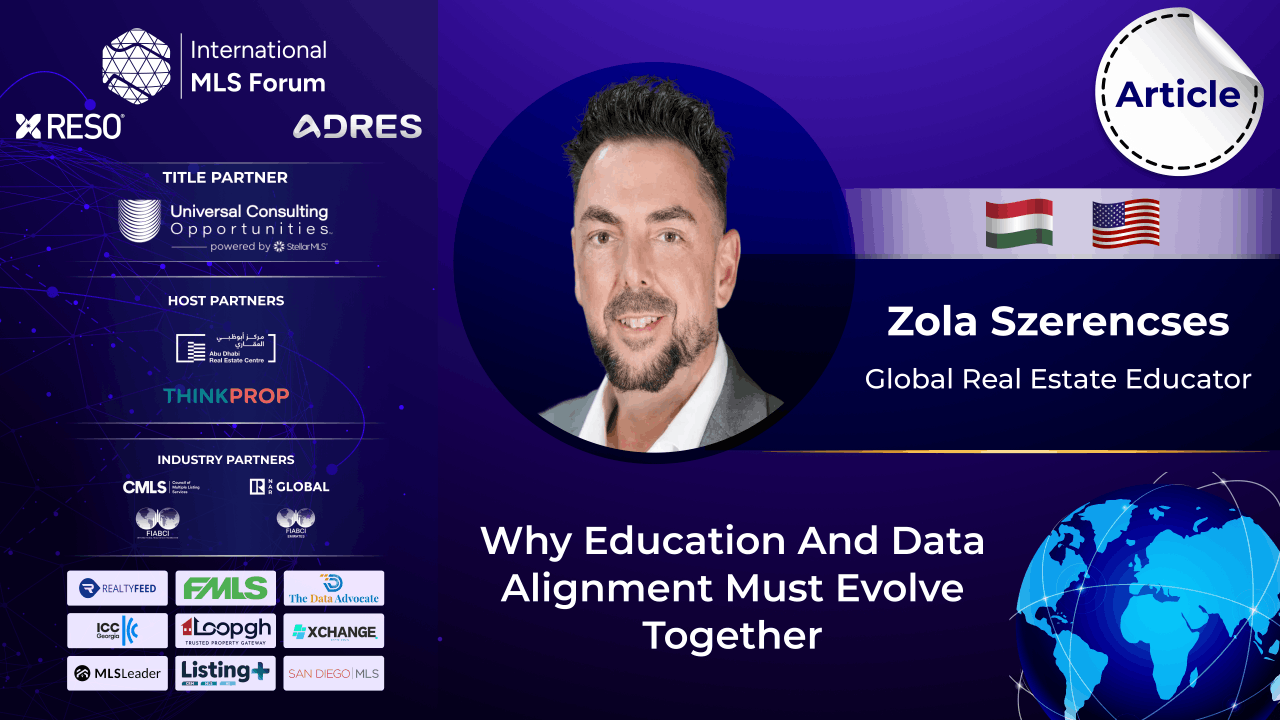
Why Education and Data Alignment Must Evolve Together
 by
by Over the years, I’ve had the privilege of educating real estate professionals and industry organizations across diverse markets — locally and internationally from emerging ecosystems to highly structured MLS environments.
One truth continues to surface:
Education alone does not elevate an industry. Alignment does.
Knowledge is essential. Certifications matter. Structured learning builds competence. But when education operates in isolation from systems, standards and collaboration, its impact remains limited.
Today’s real estate environment is no longer local in nature. Capital moves across borders. Buyers relocate internationally. Technology compresses distance. Data flows faster than ever. Yet many markets still operate within fragmented frameworks — different standards, inconsistent terminology, disconnected platforms.
This is where the conversation must mature.
Education should not be viewed as a requirement to fulfill. It should be understood as infrastructure — a foundational layer that supports professional integrity, market transparency and long-term sustainability.
But infrastructure without alignment creates friction.
Initiatives such as GDX and the International MLS Forum (IMLSF) represent more than collaboration between organizations. They reflect a recognition that professionalism must extend beyond individual capability. It must connect systems, standards, governance and leadership thinking across markets.
When executives, MLS leaders and industry strategists come together to discuss interoperability, shared frameworks and global data principles, they are not simply discussing technology. They are shaping the operational environment in which brokers and agents function every day.
Leadership decisions at the top influence behavior throughout the system.
If standards are fragmented, confusion follows. If education is disconnected from data infrastructure, execution weakens. If collaboration is optional, trust erodes.
However, alignment is not inherently virtuous.
Alignment can entrench existing models. It can unintentionally marginalize smaller players. It can scale flawed assumptions faster than ever before. Highly standardized systems can propagate errors or outdated rules across borders with remarkable efficiency.
That is why alignment must be intentional, inclusive and continually examined.
Global coherence should not eliminate local intelligence. Markets differ in regulation, culture, asset types and transaction models. True alignment does not erase diversity — it creates frameworks flexible enough to accommodate it while maintaining clarity and interoperability.
In the classroom, this tension becomes visible.
Professionals are eager to grow. They invest time and energy into developing their competence. But their effectiveness ultimately depends on the systems surrounding them. For example, when a region adopts a common data dictionary but fails to update its education, professionals may technically comply with standards yet still misinterpret status definitions — creating friction and confusion for clients. Alignment on paper does not guarantee alignment in practice.
Progress requires both.
Knowledge without structure creates inconsistency. Structure without education creates stagnation. Alignment without reflection creates risk.
The future of our industry will not be defined by who collects the most data or who delivers the most courses. It will be defined by who aligns education, standards, governance and collaboration into coherent systems — with accountability.
GDX and IMLSF signal an important evolution. They reflect a willingness among leaders to move beyond isolated optimization toward coordinated thinking. Not just within organizations but across them. Not just locally but internationally.
This is not about centralization. It is about coherence with responsibility.
As educators, MLS executives, brokers and platform leaders, the responsibility is shared. We are not only aligning systems — we are defining what professionalism looks like in practice.
Education is not the final objective.
It is the starting point.
Alignment — across systems, standards and leadership — transforms knowledge into durable impact.
But the real test is not whether we align. It is whether those alignments genuinely improve outcomes for clients — not simply convenience for institutions.